She never had the chance to learn to read.
Her daughter never stopped reading.
Wubayehu Desta was never taught to read. Her daughter picked up the habit anyway, and never let it go. Every one of her granddaughters is educated today, carrying her torch further than she was ever given the chance to.
The Desta Foundation exists to keep that insistence moving in two directions at once: forward, through a scholarship for one or two girls in rural Ethiopia at a time, and backward, through an oral history archive for elders whose stories have never been written down. It is small on purpose, and will stay small for a long while. One hand reaches ahead. One hand reaches back.
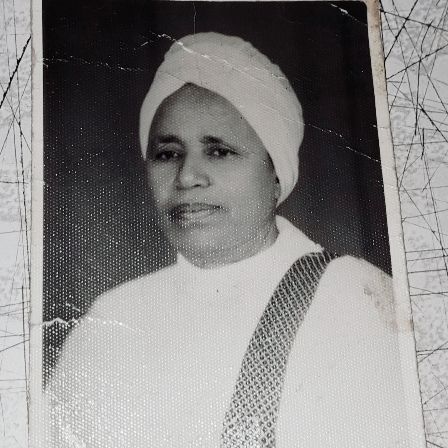
She never had the chance to learn to read. Her daughter never stopped reading.
Wubayehu Desta was never taught to read. Her daughter picked up the habit anyway, and never let it go. Every one of her granddaughters is educated today, carrying her torch further than she was ever given the chance to.
The Desta Foundation exists to keep that insistence moving in two directions at once: forward, through a scholarship for one or two girls in rural Ethiopia at a time, and backward, through an oral history archive for elders whose stories have never been written down. It is small on purpose, and will stay small for a long while. One hand reaches ahead. One hand reaches back.
Two directions
The foundation is small and deliberate. Everything it does falls under one of three headings.
A scholarship for one or two girls
The goal is much bigger than this. For now it is one or two girls, funded quietly by the family, growing slowly and deliberately from here. We fund the whole gap — fees, materials, uniforms — not part of it, and we stay with a student year to year.
An oral history archive for elders
Recorded interviews with elders who were never given the means to write their own lives down, held somewhere safe, in their own voices and their own languages.
Mentorship between generations
Pairing students with the women who came before them, so that advice, memory and encouragement move in both directions rather than skipping a generation.
An illiterate woman built a library out of her daughters.
Where it stands today
This is the beginning. The foundation is being built now, in public, by the family it belongs to. Programmes are being designed, partners are being found, and the first recordings are being planned.
If you knew Wubayehu, or you know a girl who needs a year of school paid for, or an elder whose story should be recorded, that is the help we need most right now.
Ways to help
Wubayehu Desta
A mother. A grandmother. Kind and wise — and stubborn about the one thing that mattered most: education.
She gave that love of reading to her daughter, and it took hold. That daughter carried it forward, and passed it on again. Today every one of her granddaughters is at least college educated, and several of us went further than that.
Three generations moved in one lifetime, on the strength of something she was never allowed to have for herself. This foundation is an attempt to hold on to that, and to make it do more work.
The inheritance
There is a particular kind of parent who wants something for their child that they cannot themselves demonstrate. It is harder than it sounds. You cannot read to a child if you cannot read. You cannot help with the homework. You cannot check the work, or explain the word, or point at a page and say this, this is what I mean.
You can only insist. You can decide that in this house the book is the important thing, and hold to that decision for years without ever being able to open one yourself.
That is the inheritance. Not literacy, which she did not have to give. The insistence, which she did.
Most of her life is not written down anywhere. We are gathering it now, from the people who were there. If you knew Wubayehu Desta, or you have a photograph, a letter, or a memory of her, we would like to record it.
Add to her storyA legacy meant to keep growing
The Desta Foundation exists to keep a legacy alive — not only Wubayehu Desta’s, but everyone like her whose story would otherwise go untold. A place where those stories are kept, and keeps growing.
What we do
We are currently looking for one or two girls in rural Ethiopia to fund for a four-year period, each paired with a mentor along the way. Alongside that, we record the life histories of elders who have no other way to leave one behind.
The two halves are not separate causes. A girl who is told her grandmother’s life mattered reads differently. An elder who is asked to speak into a microphone by a schoolgirl answers differently.
Why now
AI and technology have finally made it possible to record, transcribe, and preserve a life story cheaply and well. That makes it more urgent, not less, to actually do it — especially across the African continent, where so many histories still live only in memory, and nowhere else.
The same urgency runs the other way. A girl pulled out of school at thirteen for the cost of a uniform rarely returns at fourteen.
How we work
Small, and honest about it
We would rather fund twelve students completely than a hundred partially. Where we have not started something yet, this site says so.
The story belongs to the teller
Nobody is recorded without consent, nothing is published a family asks us to hold back, and every recording is kept in the language it was given in.
Local before anything else
Schools, teachers and community elders decide who needs help and who should be interviewed. We are the ones who pay for it and keep the records safe.
Built to outlast us
An archive is only worth making if it survives. Recordings are stored in more than one place, in open formats, with the family holding a copy.
Three programmes, one idea
Send girls to school. Record the elders.
Scholarships
For one or two girls in rural Ethiopia at a time. Small on purpose, and staying that way for a long while.
Girls in rural Ethiopia rarely leave school because of a single dramatic event. They leave over a uniform, an exam fee, a textbook, a bus fare, a term when the family needs another pair of hands. Each cost is small. Together they end an education.
We fund the whole gap for one student for one year at a time, and we renew rather than rotate. A scholarship that lasts four years changes a life. A scholarship that lasts one changes a semester.
The oral history archive
Recorded life histories of elders, kept safely and in their own voices.
Many elders have never had the means, the literacy or the invitation to tell their own story, let alone somewhere safe to keep it. We sit down with them, record as long as they want to talk, and hold the recording properly: transcribed, catalogued, backed up, and copied to the family.
Nothing is published without permission. The story belongs to the person who told it, and after them to their family. We are the custodians, not the owners.
Where every story goes
Every submission is copied into a private Google document the moment it arrives, logged with the date, contributor, and subject.
A second copy is kept somewhere else entirely as backup, so no single account, device, or company can lose it on its own.
We are also looking for a permanent institutional archive — a library, university, or a place like the Internet Archive — willing to hold the public stories for good, past any one family or foundation.
Stories marked public feed the newsletter — we compile and tell one elder’s story every month.
Nothing is made public without the contributor’s say. This is still evolving; if you work with archives or oral history collections and want to talk, we’d like to hear from you.
Mentorship across generations
The part that makes the other two worth doing together.
Students on scholarship are matched with women further along than they are. Some of it is practical: how to choose a subject, how to sit an exam, how to leave home for the first time. Some of it is simply being known by someone who expects you to finish.
Photographs and papers
One photograph so far. The rest of this page is waiting for the family albums, and for the work to start producing its own record.
daughters
graduation day
students
archive session
and papers
Have a photograph of Wubayehu, or of the family? Send it to us and we will add it here with a proper caption.
Five things that would help right now
None of them ask anything of your wallet.
Tell us about Wubayehu — or someone of your own
If you knew her, or your family did, we want the memory recorded before it goes. A photograph, a story, a correction to something on this site.
Mentor a student
An hour a month, by phone or in person. Most useful from women who have been through school, university, or leaving home for the first time.
Lend a skill
Archivists, translators, audio engineers, lawyers and accountants: the archive needs to be built properly the first time, and the foundation needs to be set up properly too.
Nominate an elder to interview
Someone in your family or community whose life should be on the record, and who would want to talk. We will bring the recorder and the patience.
Join our newsletter
Occasional news on the scholarship, the archive, and every new story we add. No asking for money — just updates.
Thank you. Your story is safe with us.
Someone in the family will listen or read it, and it will be kept in the archive exactly as you sent it.
Write to the foundation
Thank you — your message is with us.
Someone in the family will read it and write back.